

Understanding the Difference Before You Book
Pregnancy can include several types of ultrasound experiences, and the names can sound confusing. A medical ultrasound and an elective ultrasound may use similar imaging technology, but they are scheduled for different reasons and provide different kinds of information. Understanding that distinction helps expecting parents choose the right appointment, ask better questions, and enjoy a keepsake experience without mistaking it for medical care.
A medical ultrasound is part of prenatal healthcare. It may be ordered or performed to answer a clinical question, evaluate the pregnancy, measure development, examine anatomy, or guide follow-up care. An elective ultrasound is a non-diagnostic experience chosen by the family for bonding, viewing, and keepsake images. It complements prenatal care but never replaces an examination ordered by an OB-GYN, midwife, or other qualified healthcare provider.
Miracle Ultrasound & Spa provides elective, non-diagnostic abdominal imaging in a private in-home studio in Gainesville, Virginia. Families visit from Gainesville, Haymarket, Bristow, Manassas, Centreville, Warrenton, Woodbridge, and nearby Northern Virginia communities. The goal is to create a warm, relaxed opportunity to meet your little one before birth while maintaining clear boundaries between keepsake services and medical care.
What Is a Medical Ultrasound
A medical ultrasound is performed within a healthcare setting for a clinical purpose. Depending on the stage of pregnancy and the reason for the examination, a clinician may use it to confirm or date a pregnancy, evaluate the number of fetuses, examine anatomy, assess growth, review placental location, investigate symptoms, or monitor a known concern. The exact purpose should be explained by the ordering or treating healthcare provider.
Medical examinations follow clinical protocols. A trained professional captures the views and measurements required for the ordered study, and an appropriately qualified clinician interprets the findings. The results become part of the medical record and may influence recommendations, additional testing, referrals, or treatment.
Because the appointment has a diagnostic purpose, the sonographer may need to concentrate quietly while obtaining required images. Family enjoyment can still be part of the experience, but the medical task comes first. The length, number of pictures, guest policy, and amount of time spent viewing the face can vary according to the facility and clinical needs.
If you have pain, bleeding, decreased movement, or another health concern, contact your prenatal healthcare provider or seek appropriate urgent care. An elective appointment should never be used to investigate symptoms or decide whether a pregnancy is medically normal.
What Is an Elective Ultrasound
An elective ultrasound is a voluntary, non-diagnostic session focused on family bonding and keepsake memories. Parents may book to watch real-time movement, view facial features when visible, invite loved ones to share the moment, learn gender when conditions allow, or create images for a pregnancy journal, shower, reveal, or nursery.
The appointment does not provide a diagnosis, anatomy evaluation, NT scan, medical report, or assurance that the pregnancy is healthy. It should take place in addition to—not instead of—regular prenatal care. Families should keep every medical appointment recommended by their healthcare provider and direct clinical questions to that provider.
At Miracle Ultrasound & Spa, all sessions are performed over the abdomen. Transvaginal imaging is not offered. The atmosphere is designed to feel personal and relaxing, but the service remains structured: appointments require approval, a deposit generally secures the time, and package expectations are explained in advance.
A responsible elective provider also sets realistic expectations. Position, gestational age, placenta, fluid, hands, feet, cord, movement, and available space can all affect the view. No particular pose, gender view, facial expression, or perfectly clear portrait can be guaranteed.
Elective and Medical Ultrasound at a Glance
| Feature | Medical Ultrasound | Elective Ultrasound |
| Primary purpose | Clinical evaluation and care | Bonding and keepsake memories |
| Who determines need | Healthcare provider or clinical protocol | Expecting family |
| Measurements and diagnosis | May be included according to the ordered exam | Not provided |
| Interpretation | Qualified medical professional | No medical interpretation |
| Anatomy or NT scan | May be performed when appropriately ordered | Not performed |
| Keepsake focus | Secondary to clinical needs | Central to the experience |
| Replaces prenatal care | Part of prenatal care | No |
The Main Difference Is Purpose
The simplest way to understand the comparison is to ask why the appointment is happening. A medical ultrasound is performed because a healthcare provider needs clinical information. An elective ultrasound is selected because the family wants a bonding experience or keepsake images.
That difference in purpose affects everything else. During a medical examination, the required anatomy, measurements, documentation, and interpretation determine the workflow. During an elective session, attention centers on the live view, family participation, prints, recordings, or other keepsakes included in the chosen package.
The two services are not competitors. They work best when families understand that one protects and informs medical care while the other adds a personal experience to the pregnancy journey. A memorable elective visit should support—not weaken—the family’s commitment to prenatal healthcare.
What Medical Ultrasound Can Tell You
Only a qualified healthcare team should explain what a medical examination shows about the pregnancy. Depending on the ordered study, medical imaging may contribute information about dating, anatomy, growth, placental position, fluid, movement, blood flow, or another clinical question. Not every examination evaluates every item, and a normal-looking screen image does not replace formal interpretation.
Medical results belong in a clinical conversation. Your provider considers the images together with your health history, symptoms, physical findings, laboratory work, and other tests. If a view is incomplete or a concern is identified, the provider may recommend repeat imaging or a different type of evaluation.
Expecting parents should avoid asking an elective studio to interpret prior medical images, confirm a diagnosis, explain measurements, or provide a second medical opinion. Those questions require access to the complete record and the qualifications to practice within a diagnostic role.
What an Elective Session Can Offer
An elective visit can offer unhurried time to connect with your little one. Depending on timing and position, families may see a profile, hands, feet, stretches, turns, yawns, facial movements, or a peaceful resting pose. Real-time 4D viewing can make the experience feel especially vivid because the image changes as movement happens.
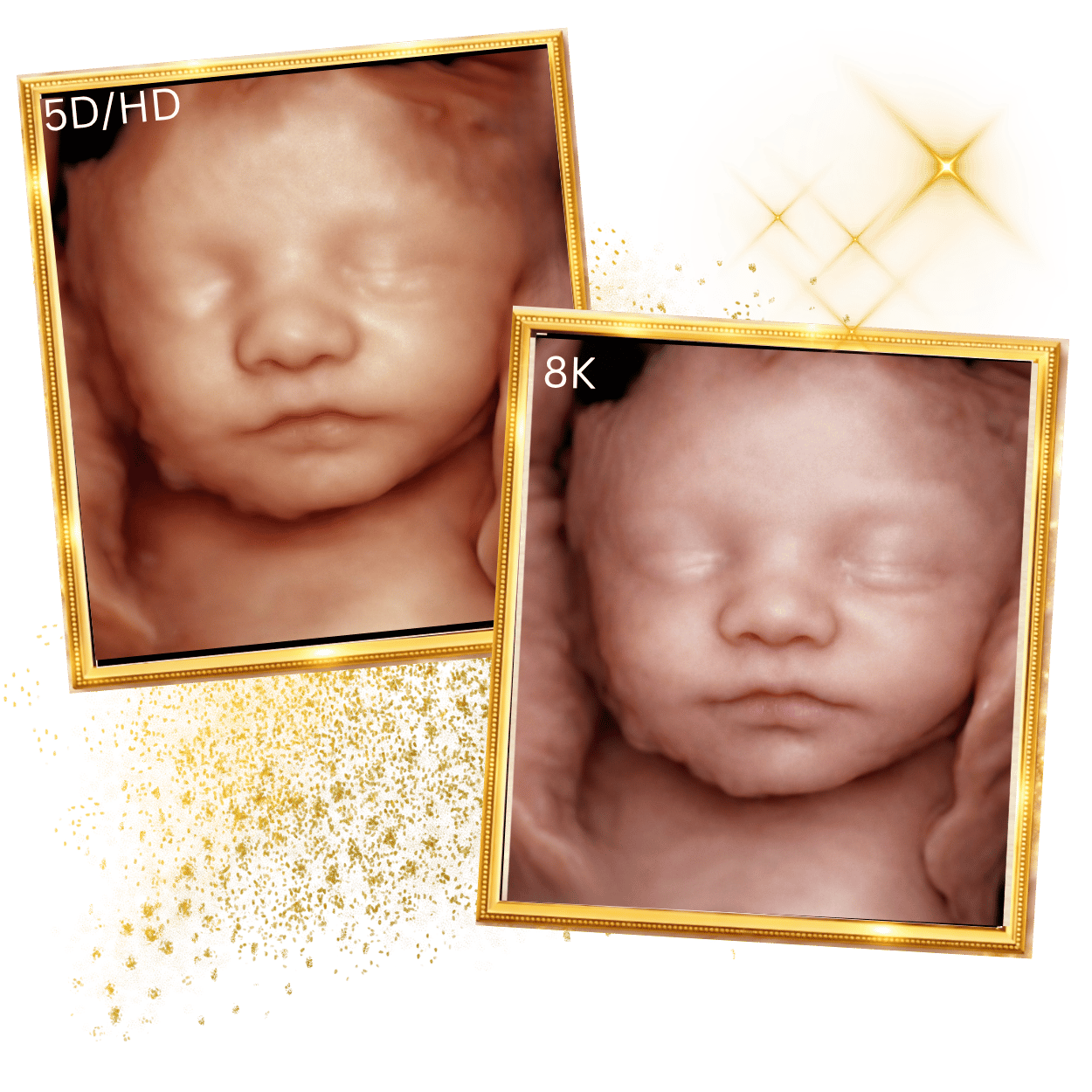
Three-dimensional imaging creates a still view with depth, while four-dimensional imaging shows 3D views in motion. Terms such as 5D and 6D often describe advanced rendering styles used by particular systems. An 8K or HD enhancement is a processed keepsake image; it is not a separate medical examination and does not reveal health information that was not present in the original capture.
Families may also receive prints or choose keepsake products depending on the package. The value is emotional rather than diagnostic: sharing a first glimpse with a partner, helping a sibling feel connected, saving a heartbeat keepsake when offered, or creating a memory that can later be compared with newborn photographs.
Why a Keepsake Image Is Not a Medical Result
A beautiful face image can feel reassuring, but it cannot establish that everything is medically normal. Elective viewing may focus on the most visually appealing angle rather than the standardized planes and measurements needed for a clinical examination. A clear profile does not evaluate all anatomy, and a visible movement does not answer every health question.
Likewise, an unclear elective image does not automatically mean that something is wrong. The face may be covered by a hand, turned toward the back, close to the placenta, or pressed against the uterine wall. The viewing window can change within minutes and from one day to another.
The safest approach is to enjoy the keepsake for what it is while relying on medical appointments for clinical answers. If the elective provider observes something outside the expected scope or cannot obtain a desired view, the family should still consult its established healthcare team rather than attempt self-interpretation.
Safety and Prudent Use
Ultrasound uses high-frequency sound waves and does not use the ionizing radiation associated with X-rays. Even so, ultrasound introduces energy into the body. The U.S. Food and Drug Administration advises prudent use and recommends minimizing exposure while obtaining the needed result. Expecting parents should choose providers who take session length, training, equipment operation, and scope seriously.
The FDA has specifically discouraged using ultrasound solely for non-medical keepsake videos and notes that unnecessary prolonged exposure or operation by untrained users may increase risk. This guidance is important and should not be hidden. Families considering an elective experience can ask how the provider keeps exposure limited, what training they have, how the equipment is maintained, and how they separate keepsake services from diagnosis.
Miracle Ultrasound & Spa keeps its role clearly non-diagnostic and uses abdominal imaging only. Families should make their own informed choice after discussing concerns with their prenatal healthcare provider. No blog post or studio policy can replace individualized medical advice.
Questions to Ask Before Booking
Start by asking whether the service is diagnostic or elective. The answer should be direct. If it is elective, the provider should clearly state that it does not replace prenatal care, anatomy imaging, NT screening, or evaluation of symptoms.
Ask about training, the route of imaging, appointment length, rescan terms, image delivery, guest limits, deposits, and what happens if the desired view is not available. Confirm whether the package includes 2D, 3D, 4D, advanced rendering, prints, a USB, a heartbeat keepsake, or image enhancement. Do not assume every advertised technology or gift is included in every package.
Ask how the studio protects privacy and handles personal information. Confirm the exact location and arrival instructions before traveling. For a gender reveal, explain who should receive the result and what should happen if position prevents a clear view.
Finally, notice whether the provider stays within scope. A trustworthy elective provider should not promise medical reassurance, diagnose a condition, interpret clinical findings, or tell you to skip care recommended by your healthcare team.
Choosing a Package at Miracle Ultrasound and Spa
Miracle Ultrasound & Spa offers several non-diagnostic options for families in Gainesville and surrounding Northern Virginia communities. Current details should be confirmed before booking because packages and promotions may change.
The First Trimester package is $150 for 30 minutes through 15 weeks. The Second Trimester package is $200 for 30 minutes from 15 through 26 weeks, and the Third Trimester package is $250 for 30 minutes from 26 through 40 weeks. A 15-minute Short Session is $165. The brief early viability keepsake option has previously been offered for $75 for pregnancies under 13 weeks, subject to current availability and policy.
The 10-minute Gender Check is $105, while the 30-minute Gender Reveal experience is $200. The VIP Second Trimester package is $299, and the VIP Third Trimester package is $350. A $50 twin fee applies, and the current 8K or HD enhancement add-on is $29.99.
A $50 non-refundable deposit generally reserves an approved appointment and is applied to the balance. Groupon voucher appointments do not require the standard deposit. Online requests require manual approval, and walk-ins are discouraged, so wait for confirmation before considering a date and time secured.

When to Schedule Each Type of Appointment
Schedule medical imaging according to your prenatal provider’s recommendations. The timing depends on your health history, symptoms, pregnancy stage, and the clinical question being addressed. Do not move, delay, replace, or cancel an ordered examination because you have an elective session scheduled.
Schedule an elective appointment according to the memory you hope to create. Earlier visits may show more of the developing body at once. Second-trimester sessions may offer broader movement and developing facial features. Third-trimester visits may show fuller facial contours when a clear window is available, although reduced space can make the view more challenging.
There is no single perfect week for every pregnancy. Placental location, position, fluid, multiples, and natural movement affect image quality. Share your estimated due date and goals when booking so the studio can explain the most appropriate elective option without giving medical scheduling advice.
What to Do When You Have a Concern
Contact your medical provider when you have a health question. Pain, bleeding, fluid leakage, fever, a significant change in movement, or any symptom that worries you deserves guidance from a qualified clinician. Follow the urgent-care or emergency instructions provided by your healthcare team.
Do not book or attend an elective ultrasound as a substitute for evaluation. A keepsake provider cannot rule out a problem, and seeing movement or a heartbeat display during an elective session does not replace a medical assessment. Similarly, difficulty obtaining an elective view should not be interpreted by the family as a diagnosis.
If you are uncertain whether your question is medical, treat it as medical and call your provider. It is better to ask the appropriate clinical team than to rely on internet searches, social media comments, home-monitoring devices, or non-diagnostic imaging.
Preparing for an Elective Appointment
Follow the studio’s booking instructions and continue any medical directions you have received. Wear comfortable clothing that allows access to the abdomen. Provide the requested identifying information and estimated due date so the appointment can be placed correctly in the system.
Maintain your usual hydration routine unless your healthcare provider has advised otherwise. Drinking an unusually large amount immediately before the session cannot guarantee a clearer face or a change in position. Avoid online tricks involving food, caffeine, activity, or other methods when they conflict with your medical instructions.
Bring flexible expectations. Your little one may be active, asleep, facing away, or covering the face. A profile or hand-on-cheek image can be just as meaningful as a straight-on portrait. Ask about the studio’s current rescan policy if facial visibility is your main goal.
Frequently Asked Questions
Can an elective ultrasound replace my anatomy scan? No. An elective session does not examine anatomy for diagnosis and cannot replace a medical scan ordered by your prenatal provider.
Will I receive a medical report? No. Miracle Ultrasound & Spa provides non-diagnostic bonding and keepsake services, not clinical interpretation or a diagnostic report.
Can an elective provider confirm that my pregnancy is healthy? No. Only your qualified healthcare team can evaluate health using the appropriate examination, records, and clinical context.
Is 3D or 4D imaging automatically diagnostic? No. The technology can be used in medical settings, but the purpose, protocol, interpretation, and provider role determine whether an examination is diagnostic. At Miracle Ultrasound & Spa, the service is elective and non-diagnostic.
What is the difference between 3D and 4D? A 3D image is a still view with depth. A 4D view displays 3D imagery in real time so families may watch movement as it happens.
Do you offer transvaginal imaging? No. Miracle Ultrasound & Spa performs abdominal imaging only.
Can you guarantee a clear face or gender view? No. Position and other natural factors affect visibility. Specific views, poses, and results cannot be guaranteed.
Should I call the studio if I have pain or bleeding? Contact your medical provider or appropriate urgent service. Do not rely on an elective appointment for symptom evaluation.
Can family members attend? Family bonding is part of the elective experience, but confirm the current guest policy before inviting a group.
Where is Miracle Ultrasound and Spa located? The private in-home studio is in Gainesville, Virginia, and serves families across nearby Northern Virginia communities. Exact arrival details are provided during the confirmed booking process.
Making an Informed Choice in Gainesville Virginia
Medical and elective ultrasound appointments can both have a place in a pregnancy journey when their roles remain clear. Medical imaging provides clinical information and belongs within prenatal healthcare. Elective imaging offers a personal opportunity to watch, connect, celebrate, and preserve keepsake memories.
For families seeking an elective ultrasound in Gainesville, VA, Miracle Ultrasound & Spa offers abdominal-only, non-diagnostic sessions in a private setting. Weekend appointments are generally available Saturday and Sunday from 8 AM to 9 PM, subject to confirmation. The studio welcomes families from Gainesville, Haymarket, Bristow, Manassas, Centreville, Warrenton, Woodbridge, and surrounding areas.
Book the experience for bonding, not reassurance. Keep every recommended medical appointment, contact your healthcare provider with concerns, and choose an elective provider that communicates honestly about scope and limitations. With those expectations in place, your keepsake session can become a warm and meaningful addition to the care you are already receiving.
Official Resources and Editorial Links
For additional information, review the U.S. Food and Drug Administration resource on ultrasound imaging and discuss questions with your prenatal healthcare provider.



 Open in Google Maps