

The short answer
A 4D ultrasound displays three-dimensional ultrasound views in motion. HD Live is an advanced rendering style that uses virtual lighting, shadow, and surface presentation to create a more dimensional or realistic-looking view from ultrasound volume information. HD Live can be shown with movement, but the terms describe different aspects of the experience.
Think of 4D as answering whether the 3D view changes over time. Think of HD Live as describing how the captured volume is illuminated and rendered on the screen. A family may watch 4D movement in a familiar golden style, an HD Live style, or another supported rendering mode.
Neither option is a camera view, and neither guarantees a clear face. Both depend on the information captured, the viewing window, the baby’s position, pregnancy stage, and the equipment and technique used.
How 2D 3D and 4D build on one another
Traditional 2D ultrasound creates cross-sectional images from returning sound information. It is the familiar black-and-white view and remains the foundation for orientation during many sessions.
Three-dimensional ultrasound combines volume information to display surface contours with depth. When the viewing window is favorable, families may recognize cheeks, lips, a nose, eyelids, fingers, or toes in a still image.
Four-dimensional ultrasound adds time to 3D. The rendered volume updates as movement occurs, allowing families to watch a stretch, turn, hand beside the face, mouth movement, or quiet change in expression. The fourth dimension is time—not a promise of higher resolution or a specific color.
What HD Live adds to the image
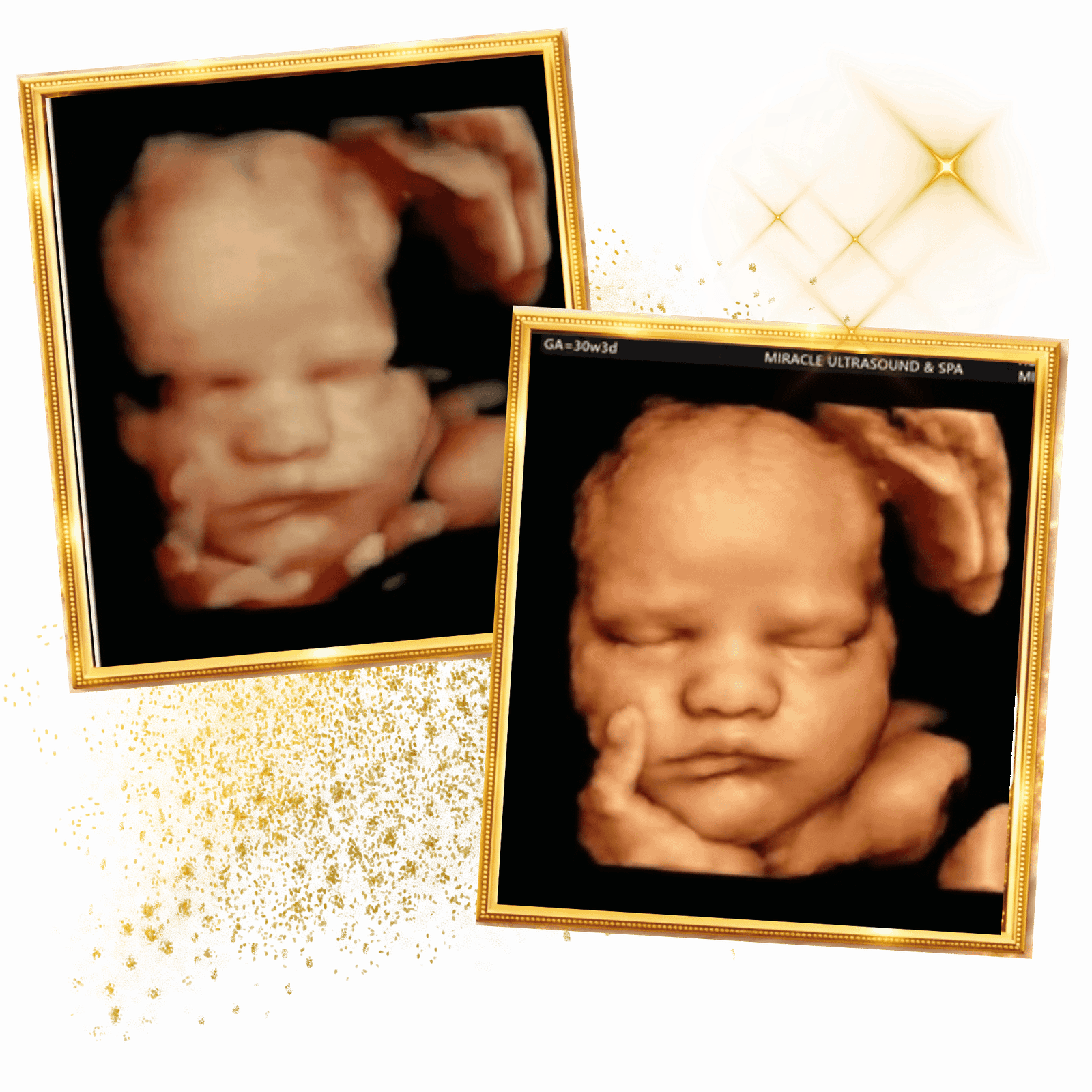
HD Live uses advanced illumination and rendering to change how surfaces and depth appear. Virtual light may be positioned to create highlights and shadows, helping the viewer perceive shape. The result can look softer, warmer, and more portrait-like than a standard surface rendering.
GE HealthCare describes HDlive as simulating light propagation and scattering through tissue. That technical description explains the visual difference: the software does not simply add a brighter filter. It models how virtual light interacts with the rendered volume to enhance depth perception.
The effect is only as useful as the underlying captured information. Good lighting cannot reveal a feature that is completely blocked, and a dramatic shadow can sometimes make a contour harder rather than easier to interpret. The operator may adjust the viewing angle and light placement to seek a natural presentation.
What families should understand about elective imaging
An elective ultrasound is a bonding and keepsake experience. It gives expecting parents time to watch natural movement, include loved ones, and preserve images or video from pregnancy. It does not replace a medical ultrasound ordered by an OB/GYN, midwife, maternal-fetal medicine specialist, or another qualified healthcare professional.
A medical ultrasound has a clinical purpose. Depending on the provider’s order, it may evaluate dating, anatomy, growth, placental location, fluid, fetal position, or another medical question. The American College of Obstetricians and Gynecologists explains that a standard prenatal ultrasound is commonly performed between 18 and 22 weeks. Families should keep that appointment and every other examination recommended by their prenatal team.
Miracle Ultrasound & Spa provides elective, non-diagnostic abdominal imaging. The studio does not perform anatomy scans, NT scans, transvaginal examinations, diagnose medical conditions, confirm viability, issue medical reports, or replace routine prenatal care. Pain, bleeding, leaking fluid, decreased movement, pregnancy complications, or other concerning symptoms should be discussed promptly with a healthcare provider rather than evaluated through a keepsake visit.
How pregnancy stage changes a keepsake visit
Early pregnancy is usually best appreciated through 2D images. Depending on exact dating and viewing conditions, families may see a gestational sac, yolk sac, a tiny developing baby, early movement, or cardiac activity when detectable. These views can be deeply meaningful, but they are not the detailed facial portraits associated with later pregnancy.
During the second trimester, more of the body may fit within one view. Families may notice a profile, arms, legs, hands, feet, stretches, turns, or developing facial features. A private session at this stage remains separate from the clinical anatomy examination.
From approximately 26 through 32 weeks, facial contours may appear fuller while there may still be enough space for a useful viewing window. This range is popular for 3D, 4D, HD Live, and enhanced keepsakes, but it is a planning range rather than a guarantee. A baby who faces away, covers the face, or rests close to surrounding tissue may provide a limited portrait at any week.
Later pregnancy can show fuller cheeks and a more newborn-like profile, but available space becomes tighter. Parents should approach every stage with flexible expectations and value the authentic view available that day.
What determines a clear facial image
Image clarity depends on more than equipment or appointment length. Position, pregnancy stage, movement, nearby tissue, the sound path, the viewing angle, and fluid in front of the feature all affect what appears. A face turned toward an accessible window may show recognizable contours. A face turned toward the parent’s spine or pressed close to tissue may look shadowed, flattened, blended, or incomplete.
Hands and feet often rest near the face. That can limit a full portrait while creating a genuine pose families love. A quick turn may briefly reveal a strong frame; movement may also soften a still image captured mid-motion.
No studio can guarantee a particular expression, movement, gender view, front-facing portrait, or exact resemblance. Longer appointments provide more time and a broader experience, but they do not control the baby’s position. A responsible keepsake session protects comfort and uses the best naturally available view.
HD Live and 4D are not competing choices
Families often ask which is better, HD Live or 4D, but the question treats them as opposites. Four-dimensional imaging refers to moving 3D volume views. HD Live refers to a way of rendering and lighting volume data. They can work together.
During one session, a family may see standard 2D for orientation, 3D still images, 4D movement, and HD-style rendering. Each offers a different way to appreciate the same visit. One mode may show motion clearly; another may provide the favorite still portrait.
The best view can change from minute to minute. A standard rendering may outline the lips cleanly while HD Live gives the cheeks more depth. A moving 4D sequence may explain why a still image contains a hand near the face.
What families may notice on the screen
In favorable conditions, standard 4D may show a warm surface view that is easy to follow as the baby moves. Families often enjoy the immediacy of seeing a stretch, yawn-like mouth motion, turn, or hand-to-face gesture as it happens.
HD Live may make light direction, shadow, and surface curvature more noticeable. A three-quarter pose can appear especially dimensional because one side of the face is illuminated while the other carries softer shadow.
Neither appearance should be judged as the one true version of the baby’s face. Both are rendered from ultrasound information. The visible result changes with angle, settings, movement, tissue, and the available sound window.
When HD Live may be most rewarding
Many families plan facial imaging around 26 to 32 weeks. Features may be fuller than earlier in pregnancy, while there may still be enough room around the face for surface rendering. This window can support 3D, 4D, and HD Live keepsakes when position cooperates.
Earlier sessions can still show meaningful movement and developing features, but the face may look less full. Later sessions can reveal rounder cheeks, yet the viewing window may be tighter. Timing is one factor among several, not a guarantee.
A profile can be as beautiful as a front view. When the baby faces the parent’s spine or rests close to nearby tissue, another angle may not be available regardless of rendering mode.
How HD Live differs from an 8K enhancement
HD Live generally describes a rendering mode used with ultrasound volume information during the imaging experience. An Ultra Real HD or 8K enhancement is a processed keepsake portrait created from a selected captured frame after or apart from the live viewing.
HD Live changes how the volume is illuminated and displayed. An 8K enhancement may refine the apparent clarity, tone, texture, and overall presentation of one selected image. Neither is a separate medical scan dimension.
At Miracle Ultrasound & Spa, Ultra Real HD or 8K enhancement is currently listed at $29.99 and may be included in the VIP package when applicable. Families should keep the original image with the enhanced portrait.
Choosing a package for motion or facial images
A family wanting to watch movement should look for a package that includes 4D video or movement clips. A family prioritizing facial portraits should consider pregnancy timing, session length, source-image quality, and whether the package includes 3D, HD-style views, prints, or an optional enhancement.
Third Trimester Prime Time is currently $275 for 30 minutes from 26 through 40 weeks. It lists multiple 2D, 3D, and 4D HD images and videos, prints, heartbeat recording, digital delivery, a family photo, no posted guest limit, and the success guarantee.
The VIP package currently lists 2D, 3D, 4D, 5D, and 6D presentation, a 30-to-35-minute session, prints, digital images and video, heartbeat recording, a family photo, keepsakes, and an Ultra Real HD or 8K portrait from 26 weeks onward when applicable. Confirm live details before booking.
Frequently asked questions about HD Live and 4D
Is HD Live the same as 4D? No. 4D refers to 3D views in motion, while HD Live describes an advanced lighting and rendering approach. HD Live may be used with moving volume views.
Is HD Live safer or stronger than ordinary ultrasound? It is a display and rendering technology, not a reason to extend exposure. Ultrasound should be used prudently by trained professionals.
Does HD Live show the baby’s real skin color? No. The colors and lighting are part of the rendering. They do not reveal actual skin tone.
Can HD Live see through a hand or placenta? No. It cannot reveal a face that was not accessible in the captured information.
What week is best? Many families plan facial keepsakes around 26 to 32 weeks, but position and viewing conditions matter at every stage.
Does HD Live replace a medical ultrasound? No. Elective HD Live and 4D viewing is for bonding and keepsakes, not diagnosis or prenatal assessment.
Enjoy each view for what it contributes
4D helps families watch three-dimensional views change with movement. HD Live adds virtual lighting, shadow, and surface rendering that can make the same volume appear more dimensional and portrait-like. One describes motion; the other describes presentation.
The most memorable session often uses several views together. A 2D image can orient the family, a 4D clip can capture movement, an HD Live frame can emphasize depth, and an enhanced portrait can create a polished keepsake.
Miracle Ultrasound & Spa in Gainesville offers private bonding experiences for families across Northern Virginia. Choose the package that matches your stage and goals, maintain realistic expectations, and continue every medical appointment recommended by your prenatal provider.
Preparing for a relaxed private appointment
Follow the preparation instructions in the approved appointment confirmation rather than relying on one-size-fits-all advice from social media. Wear comfortable clothing that allows access to the abdomen. Arrive on time and allow extra travel time during busy Northern Virginia weekends or evenings.
Choose guests who help the expectant parent feel calm. Full sessions are designed to include family participation, while shorter options may have different guest limits. Confirm the current policy before arrival, especially when children or a larger group will attend.
Begin with one realistic priority: facial images, natural movement, a shared family moment, gender determination when included, or a final pregnancy keepsake. A successful appointment does not require a perfect front-facing portrait. A profile, tiny foot, stretch, hand beside the cheek, heartbeat moment, or curled pose can become the favorite memory.
Booking policies and Northern Virginia service area
Miracle Ultrasound & Spa is located at a private, spa-like studio in Gainesville, Virginia. The business welcomes families from Haymarket, Bristow, Manassas, Nokesville, Centreville, Fairfax, Warrenton, South Riding, Woodbridge, and surrounding Northern Virginia communities. Mobile service may be available for an additional travel fee, although the studio visit offers the most controlled environment.
Appointments are currently listed seven days a week and are available by appointment. A $50 deposit reserves an approved appointment and is applied to the selected package. Deposits are noncancelable and nonrefundable, and the posted policy requires advance notice to reschedule. Confirm the live booking page because availability, promotions, inclusions, and policies can change.
Before paying, confirm the package, pregnancy range, session length, guest policy, deposit, rescheduling terms, twin fee, mobile fee, enhancement eligibility, deliverables, and rescan terms shown in the final confirmation.
Saving and sharing pregnancy keepsakes
Download original digital files at full quality and save them in at least two secure places. Messaging apps and repeated screenshots can reduce image quality. Label the folder with the pregnancy week and appointment date so the files remain easy to recognize later.
Before posting publicly, crop names, dates of birth, appointment details, or other identifiers. Ask the expectant parent before relatives repost pictures or videos. Businesses should use client images only with clear permission.
Keep an original ultrasound image beside any enhanced portrait. The original preserves the authentic pose and viewing conditions; the enhancement provides a polished artistic presentation. Neither should be interpreted as medical information or an exact prediction of newborn appearance.
Current package guide at Miracle Ultrasound and Spa
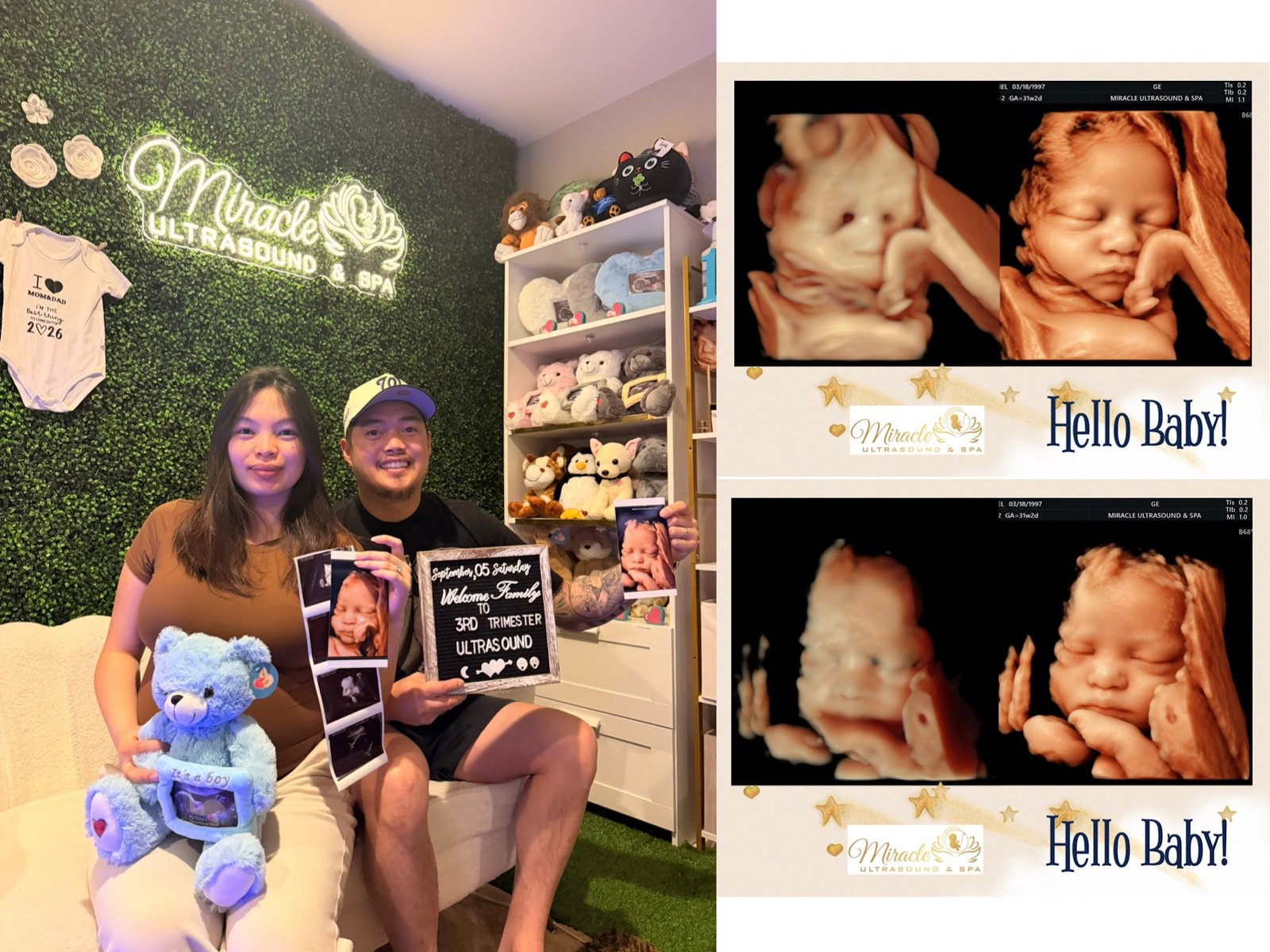
The live website currently lists Third Trimester Prime Time at $275 for a 30-minute session from 26 through 40 weeks. It includes multiple 2D, 3D, and 4D HD images and videos, heartbeat recording, five black-and-white prints, two color prints, same-day digital images, optional simple keepsake measurements, gender determination when requested, a family photo, no posted guest limit, and the posted success guarantee.
Miracle Final Peek is listed at $195 for a 20-minute 2D bonding session from 35 through 40-plus weeks. It includes viewing position and movement, checking the heartbeat when detectable, optional simple keepsake measurements, two black-and-white prints, digital images, a family photo, and no posted guest limit. It does not replace the OB provider’s assessment of growth, fluid, presentation, or delivery readiness.
VIP is listed at $299 in the second trimester and $350 in the third trimester. The 2 Pair Miracle is $375, and Miracle Unlimited is $1,199. Ultra Real HD or 8K enhancement is currently $29.99 as an add-on and is included with the VIP package when applicable. Prices, pregnancy ranges, promotions, and inclusions can change, so confirm the live booking page before purchasing.
Does HD Live replace a medical ultrasound? No. Elective HD Live and 4D viewing is for bonding and keepsakes, not diagnosis or prenatal assessment. It does not replace the OB provider’s assessment of growth, fluid, presentation, or delivery readiness.
Editorial references
Miracle Ultrasound & Spa. Current packages, pricing, policies, service areas, and booking information. https://miracleultrasoundspa.com/book-online/
American College of Obstetricians and Gynecologists. Ultrasound Exams. https://www.acog.org/womens-health/faqs/ultrasound-exams
U.S. Food and Drug Administration. Ultrasound Imaging. https://www.fda.gov/radiation-emitting-products/medical-imaging/ultrasound-imaging
GE HealthCare. HDlive technology and advanced volume-rendering descriptions. https://www.gehealthcare.com/




 Open in Google Maps