

The short answer
Later in pregnancy, sound from outside the body can reach the developing baby, although it is softened and changed as it travels through the parent’s body and surrounding fluid. ACOG notes that hearing develops during pregnancy and that a fetus can hear sounds around week 18. The CDC states that fetuses begin responding to sound around week 24.
That does not mean every movement seen during a 4D ultrasound is a response to music. Babies move, stretch, turn, rest, swallow, and bring their hands toward the face for many reasons. Timing alone cannot prove cause.
Music can create a warm atmosphere for the family when played at a comfortable room level. It should never be placed directly against the abdomen at high volume or used to make the baby perform. The purpose is connection, not stimulation.
How fetal hearing develops
The auditory system begins developing early in pregnancy, but development is gradual. Structures must form, neural pathways continue maturing, and the brain keeps learning to process sound after birth. Hearing in the womb should not be imagined as identical to adult hearing in a quiet room.
ACOG’s pregnancy-development information states that hearing begins to develop earlier and that sounds may be heard around week 18. CDC guidance says the ears develop by approximately week 20 and responses to sound may begin around week 24. These timelines describe general development, not a test that can be confirmed during an elective appointment.
Each pregnancy is individual. A visible movement during a song cannot diagnose hearing ability, and a quiet baby does not indicate a hearing problem. Medical questions about development belong with the prenatal care team.
What music may sound like inside the womb
External sound travels through air, the parent’s tissues, and fluid before reaching the baby. The womb is not silent: the baby is also surrounded by internal sounds such as the parent’s heartbeat, breathing, digestive activity, and voice transmitted through the body.
Higher and lower frequencies do not travel in exactly the same way, and outside music may sound muffled compared with what the family hears in the room. The rhythm and lower-frequency components may be more noticeable than crisp lyrics or delicate high notes.
Because the baby’s exact experience cannot be known from the screen, families should avoid claims that a particular song was recognized. It is more accurate to say the family shared music while watching the baby’s naturally occurring activity.
What families should understand about elective imaging
An elective ultrasound is a bonding and keepsake experience. It gives expecting parents time to watch natural movement, include loved ones, and preserve images or video from pregnancy. It does not replace a medical ultrasound ordered by an OB/GYN, midwife, maternal-fetal medicine specialist, or another qualified healthcare professional.
A medical ultrasound has a clinical purpose. Depending on the provider’s order, it may evaluate dating, anatomy, growth, placental location, fluid, fetal position, or another medical question. The American College of Obstetricians and Gynecologists explains that a standard prenatal ultrasound is commonly performed between 18 and 22 weeks. Families should keep that appointment and every other examination recommended by their prenatal team.
Miracle Ultrasound & Spa provides elective, non-diagnostic abdominal imaging. The studio does not perform anatomy scans, NT scans, transvaginal examinations, diagnose medical conditions, confirm viability, issue medical reports, or replace routine prenatal care. Pain, bleeding, leaking fluid, decreased movement, pregnancy complications, or other concerning symptoms should be discussed promptly with a healthcare provider rather than evaluated through a keepsake visit.
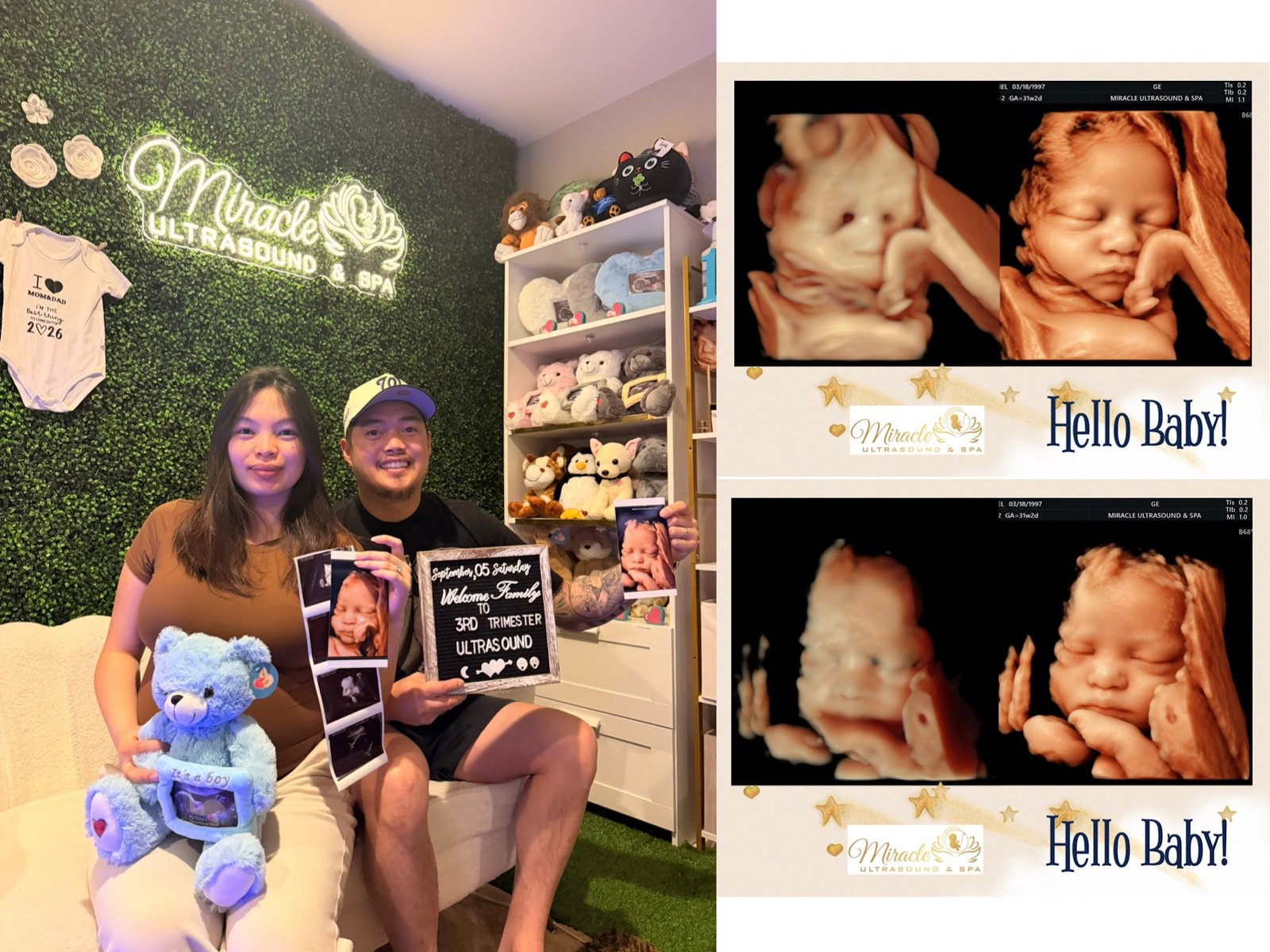
How pregnancy stage changes a keepsake visit
Early pregnancy is usually best appreciated through 2D images. Depending on exact dating and viewing conditions, families may see a gestational sac, yolk sac, a tiny developing baby, early movement, or cardiac activity when detectable. These views can be deeply meaningful, but they are not the detailed facial portraits associated with later pregnancy.
During the second trimester, more of the body may fit within one view. Families may notice a profile, arms, legs, hands, feet, stretches, turns, or developing facial features. A private session at this stage remains separate from the clinical anatomy examination.
From approximately 26 through 32 weeks, facial contours may appear fuller while there may still be enough space for a useful viewing window. This range is popular for 3D, 4D, HD Live, and enhanced keepsakes, but it is a planning range rather than a guarantee. A baby who faces away, covers the face, or rests close to surrounding tissue may provide a limited portrait at any week.
Later pregnancy can show fuller cheeks and a more newborn-like profile, but available space becomes tighter. Parents should approach every stage with flexible expectations and value the authentic view available that day.
What determines a clear facial image
Image clarity depends on more than equipment or appointment length. Position, pregnancy stage, movement, nearby tissue, the sound path, the viewing angle, and fluid in front of the feature all affect what appears. A face turned toward an accessible window may show recognizable contours. A face turned toward the parent’s spine or pressed close to tissue may look shadowed, flattened, blended, or incomplete.
Hands and feet often rest near the face. That can limit a full portrait while creating a genuine pose families love. A quick turn may briefly reveal a strong frame; movement may also soften a still image captured mid-motion.
No studio can guarantee a particular expression, movement, gender view, front-facing portrait, or exact resemblance. Longer appointments provide more time and a broader experience, but they do not control the baby’s position. A responsible keepsake session protects comfort and uses the best naturally available view. Hands and feet often rest near the face. That can limit a full portrait while creating a genuine pose families love. A quick turn may briefly reveal a strong frame; movement may also soften a still image captured mid-motion.
What families may notice during 4D viewing
Four-dimensional ultrasound displays 3D views in motion. Depending on pregnancy stage and position, families may see a stretch, turn, hand movement, mouth motion, kick, quiet resting pose, or brief change in facial presentation while music plays.
A baby may become more active, remain still, or move before the music even begins. The screen provides a real-time sequence, but it does not identify why a movement occurred. A turn during a chorus may feel meaningful to the family without becoming scientific proof of a response. Hands and feet often rest near the face. That can limit a full portrait while creating a genuine pose families love. A quick turn may briefly reveal a strong frame; movement may also soften a still image captured mid-motion.
The best approach is observational: describe what is visible without assigning a medical or behavioral interpretation. Phrases such as ‘the baby moved while the song was playing’ are more accurate than ‘the baby loves this song.’
Why a quiet baby may still create a beautiful visit
Babies have periods of activity and rest. A quiet pose can create a strong still image because there is less motion blur. A hand beside the cheek, relaxed profile, crossed feet, or curled position may become the most treasured frame.
Turning up the music is not an appropriate solution when the baby remains quiet. Volume should stay comfortable for everyone in the room. Position and rest are part of the authentic experience, not problems that must be corrected.
Families can use a quiet moment to notice the profile, fingers, toes, or breathing-like motion when visible. The appointment remains meaningful even without a dramatic reaction.
Keep sound comfortable and avoid very loud noise
Everyday conversation and music at a comfortable room level are different from hazardous noise exposure. CDC guidance warns that very loud noise during pregnancy may pose risk to developing hearing and notes that sound can travel through the body.
Do not place a speaker, headphones, or vibrating device directly against the abdomen. Do not use sudden loud sounds to startle the baby for a video. If people need to raise their voices to communicate, the environment is louder than necessary for a relaxing session.
Anyone with questions about occupational noise, concerts, loud events, or repeated exposure should speak with a healthcare provider. An elective studio should not provide individualized medical clearance.
Choosing music for a family bonding experience
Choose music that helps the expectant parent feel relaxed. A favorite lullaby, meaningful family song, gentle instrumental track, or softly played cultural song can add emotion without turning the appointment into a performance.
Keep the playlist short and easy to control. Ask the studio before arrival whether personal music is permitted and how it can be played. Avoid explicit lyrics when children or other families may be nearby.
The music belongs to the family memory. Years later, hearing the same song may bring back the room, the screen, the relatives who attended, and the movement that happened naturally that day.
Music does not improve image quality
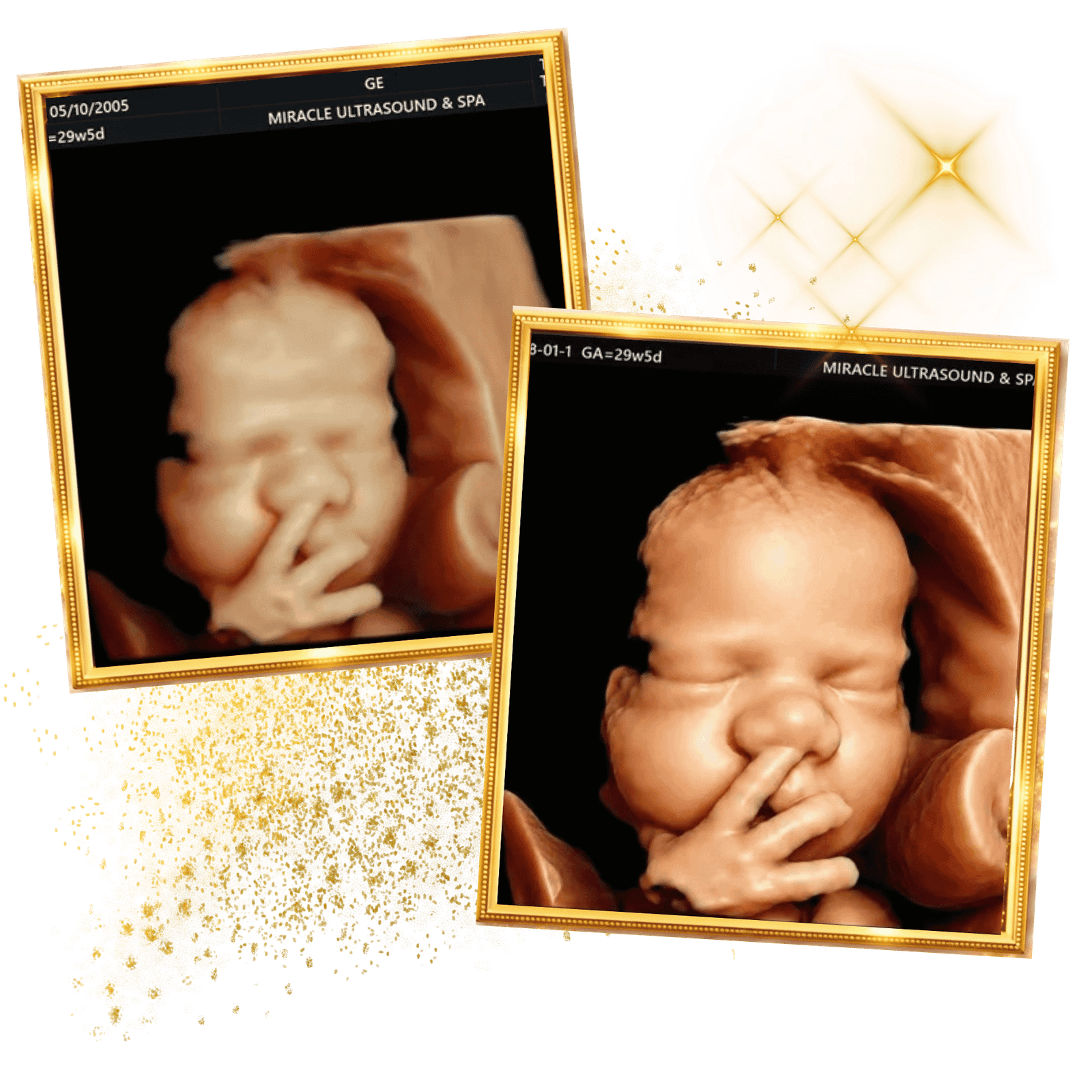
A song cannot create a clearer face, increase fluid, remove a hand, or change the viewing angle. Image quality still depends on pregnancy stage, position, movement, nearby tissue, fluid in front of the feature, and the sound path.
If the baby turns away while music plays, the movement may actually reduce the facial view. If the baby remains still in a favorable profile, the quiet pose may support a better image. Neither outcome indicates a preference for the music.
Choose a 4D package for the experience and included keepsakes, not because music is expected to produce a particular pose.
Frequently asked questions about music and 4D ultrasound
Can the baby hear music during the appointment? Later in pregnancy, external sounds may reach the baby, but the sound is filtered and the exact experience cannot be known from the screen.
When does hearing develop? ACOG notes that a fetus can hear sounds around week 18, while CDC guidance notes responses to sound around week 24. Development continues throughout pregnancy and after birth.
Does movement prove the baby heard the song? No. Ultrasound can show movement but cannot establish why it occurred.
What if the baby does not move? Quiet periods are normal behavior during a visit and do not diagnose hearing or health.
Should headphones be placed on the belly? No. Keep music at a comfortable room level and do not place speakers or vibrating devices directly against the abdomen.
Can loud music be harmful? CDC advises avoiding very loud noise during pregnancy because it may affect developing hearing.
Does 4D test fetal hearing? No. A 4D keepsake session is not a hearing test, medical examination, or developmental assessment.
Let music support the memory without creating pressure
Your baby may be able to hear aspects of outside music later in pregnancy, and your family may notice movement while a song plays. The responsible conclusion is simple: the two events happened together. The screen cannot prove recognition, preference, or hearing ability.
At Miracle Ultrasound & Spa in Gainesville, a 4D bonding session can include music as part of a calm family atmosphere when studio policy permits. Keep the volume comfortable, let the baby move or rest naturally, and enjoy the authentic moment available.
Continue every prenatal appointment and bring hearing or development questions to your healthcare provider. Let the song become part of your family story rather than a test your baby is expected to pass.
Preparing for a relaxed private appointment
Follow the preparation instructions in the approved appointment confirmation rather than relying on one-size-fits-all advice from social media. Wear comfortable clothing that allows access to the abdomen. Arrive on time and allow extra travel time during busy Northern Virginia weekends or evenings.
Choose guests who help the expectant parent feel calm. Full sessions are designed to include family participation, while shorter options may have different guest limits. Confirm the current policy before arrival, especially when children or a larger group will attend.
Begin with one realistic priority: facial images, natural movement, a shared family moment, gender determination when included, or a final pregnancy keepsake. A successful appointment does not require a perfect front-facing portrait. A profile, tiny foot, stretch, hand beside the cheek, heartbeat moment, or curled pose can become the favorite memory.
Booking policies and Northern Virginia service area
Miracle Ultrasound & Spa is located at a private, spa-like studio in Gainesville, Virginia. The business welcomes families from Haymarket, Bristow, Manassas, Nokesville, Centreville, Fairfax, Warrenton, South Riding, Woodbridge, and surrounding Northern Virginia communities. Mobile service may be available for an additional travel fee, although the studio visit offers the most controlled environment.
Appointments are currently listed seven days a week and are available by appointment. A $50 deposit reserves an approved appointment and is applied to the selected package. Deposits are noncancelable and nonrefundable, and the posted policy requires advance notice to reschedule. Confirm the live booking page because availability, promotions, inclusions, and policies can change.
Before paying, confirm the package, pregnancy range, session length, guest policy, deposit, rescheduling terms, twin fee, mobile fee, enhancement eligibility, deliverables, and rescan terms shown in the final confirmation.
Saving and sharing pregnancy keepsakes
Download original digital files at full quality and save them in at least two secure places. Messaging apps and repeated screenshots can reduce image quality. Label the folder with the pregnancy week and appointment date so the files remain easy to recognize later.
Before posting publicly, crop names, dates of birth, appointment details, or other identifiers. Ask the expectant parent before relatives repost pictures or videos. Businesses should use client images only with clear permission.
Keep an original ultrasound image beside any enhanced portrait. The original preserves the authentic pose and viewing conditions; the enhancement provides a polished artistic presentation. Neither should be interpreted as medical information or an exact prediction of newborn appearance.

Current package for your baby, guide at Miracle Ultrasound and Spa
The live website currently lists Third Trimester Prime Time at $275 for a 30-minute session from 26 through 40 weeks. It includes multiple 2D, 3D, and 4D HD images and videos, heartbeat recording, five black-and-white prints, two color prints, same-day digital images, optional simple keepsake measurements, gender determination when requested, a family photo, no posted guest limit, and the posted success guarantee.
Miracle Final Peek is listed at $195 for a 20-minute 2D bonding session from 35 through 40-plus weeks. It includes viewing position and movement, checking the heartbeat when detectable, optional simple keepsake measurements, two black-and-white prints, digital images, a family photo, and no posted guest limit. It does not replace the OB provider’s assessment of growth, fluid, presentation, or delivery readiness.
VIP is listed at $299 in the second trimester and $350 in the third trimester. The 2 Pair Miracle is $375, and Miracle Unlimited is $1,199. Ultra Real HD or 8K enhancement is currently $29.99 as an add-on and is included with the VIP package when applicable. Prices, pregnancy ranges, promotions, and inclusions can change, so confirm the live booking page before purchasing.
Editorial references
Miracle Ultrasound & Spa. Current packages, pricing, policies, service areas, and booking information. https://miracleultrasoundspa.com/book-online/
American College of Obstetricians and Gynecologists. Ultrasound Exams. https://www.acog.org/womens-health/faqs/ultrasound-exams
U.S. Food and Drug Administration. Ultrasound Imaging. https://www.fda.gov/radiation-emitting-products/medical-imaging/ultrasound-imaging
GE HealthCare. HDlive technology and advanced volume-rendering descriptions. https://www.gehealthcare.com/



 Open in Google Maps